




The dream of having your own cinema - a huge, razor-sharp picture that lets you immerse yourself completely in the action. Today, that dream is more accessible than ever before. But with the wealth of new technology, one crucial question arises: Is it really worth making the financial leap from a tried-and-tested Full HD device to a modern 4K projector?
This guide looks beyond the marketing buzzwords. We will examine the two technological pillars of the modern projection – Resolution (4K) and light source (laser) – systematically deconstruct. The goal is to equip you with the well-founded knowledge you need to make an informed decision that is right for you.
What does the 4K projector really offer?
A 4K projector offers a significant improvement in four key areas, turning simply watching a screen into a true cinema experience. Primarily, it delivers:
-
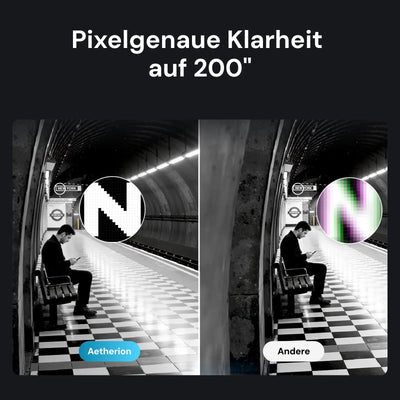
1. Extreme attention to detail and clarity: With over 8 million pixels—four times as many as Full HD—the image is incredibly sharp. This eliminates the so-called "screen door effect" (the visible pixel grid), resulting in a smooth, film-like picture, especially on large screens.
-
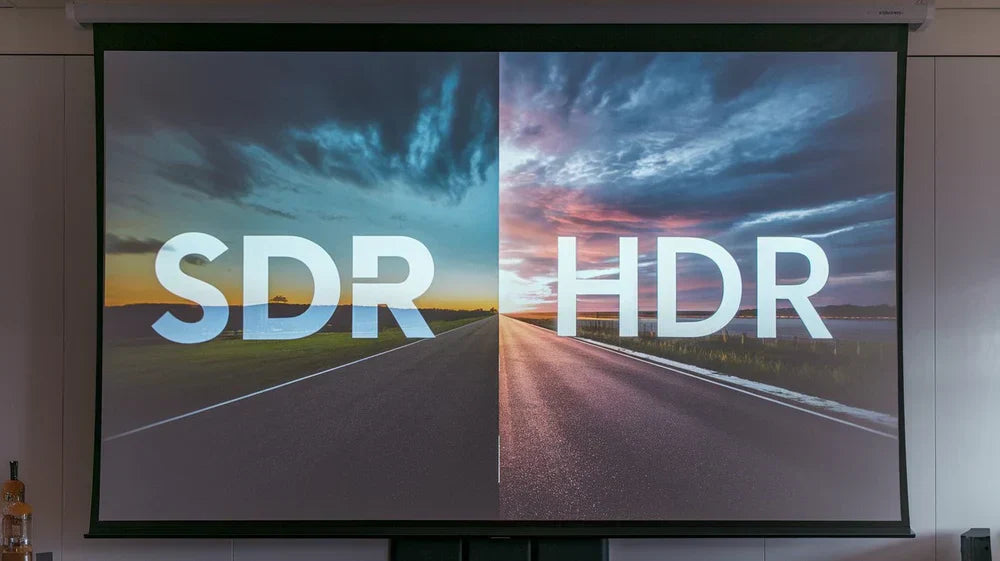
2. Enhanced Color and Depth (HDR): Beyond pure sharpness, 4K projectors also offer High Dynamic Range (HDR), which delivers brighter highlights, more detailed shadows, and a wider range of vivid, true-to-life colors. This gives the image noticeably more realism and "pop."
-
3. Future-proof technology: 4K is the established standard for high-quality content, whether on major streaming services (Netflix, Disney+), modern game consoles (PS5, Xbox Series X), or physical media (4K UHD Blu-ray). Investing in 4K ensures compatibility for the years ahead.
-
4. True cinematic immersion: The high resolution retains its integrity even at huge screen diagonals of 100 to 150 inches (approx. 2.5 to 3.8 meters) and beyond. This creates an immersive effect that a television simply cannot replicate.
Column 1: Decoding 4K resolution
1. More Than One Name: UHD vs. DCI 4K
Although the term “4K” is ubiquitous, in the home sector it refers to the standard Ultra High Definition (UHD) with a resolution of 3840 x 2160 pixels. Since this corresponds exactly to four times the Full HD resolution, upscaling content is simplified. This should be distinguished from the slightly wider DCI 4K standard (4096 x 2160 pixels), which is used in the professional cinema sector.
2. The Core Difference: How the 8.3 Million Pixels Are Generated
Technology A: Native 4K
This technology, used in premium home theater projectors, uses an imaging chip with a physical grid of 8.3 million individual pixels. This is the most direct and purest method of producing a 4K image. However, the complex and error-prone manufacturing process for these large, flawless chips results in a significant price premium.
Technology B: Advanced Pixel Shifting (4K Enhancement)
This smart and widely used technology combines a lower-resolution chip (usually 1920x1080) with a high-precision actuator. It shifts the chip multiple times per frame in a fraction of a second (e.g. diagonally by half a pixel width). The human eye integrates these rapidly successive, overlapping images into a single high-resolution overall image. This method is so effective that it is certified as “True 4K UHD” by the Consumer Technology Association (CTA) and enables projectors at a much more accessible price.
Column 2: The Revolution of the Light Source (Lamp vs. Laser)
1. The disadvantages of traditional lamps
Classic projector lamps have critical drawbacks: a short lifespan (2,000-6,000 hours) with high replacement costs, long warm-up and cool-down times, and high heat generation with loud fans. The most critical point, however, is this: brightness decreases rapidly and non-linearly. A lamp can lose up to 25% of their original brightness in the first 500 hours, which noticeably changes the image quality over time.
2. The benefits of laser illumination
Laser light sources solve these problems. They offer an extremely long service life of 20,000 hours or more and are virtually maintenance-free. Their key advantage is the slow and linear drop in brightness, which far more consistent image performance over the entire service life. They also enable a immediate operational readiness (Instant On/Off), allowing a projector to be used like a TV – a key requirement for modern "lifestyle" concepts.
3. How Laser Light Works (Simplified)
-
Single-laser phosphor: This is the most common design. A blue laser excites a rotating wheel coated with phosphor to produce yellow light. This is split into red and green light components and combined with the original blue light to create an overall white light.
-
Triple Laser (RGB): This is the most advanced design. Three separate lasers for red, green, and blue create the image. This method requires no color or phosphor wheels, resulting in exceptionally pure colors and the widest possible color gamut. Devices such as the AWOL Vision LTV-3500 Pro exactly this technology to achieve an impressive color result of 107% of the BT.2020 color gamut to achieve.
Beyond the Basics: Specifications That Really Matter
1. Brightness: ISO lumens and the reality in cinema mode
Achten Sie ausschließlich auf standardisierte Helligkeitsangaben wie ISO lumens (according to ISO 21118). Do not ignore non-standardized marketing terms. Note the crucial practical tip: A projector reaches its maximum brightness in the least color-accurate mode. In the calibrated "Cinema" or "Filmmaker" mode, the actual brightness can 40–50% lower be lower. A higher initial ISO lumen value provides more headroom for a bright and powerful image after calibration.
2. Contrast: Native vs. Dynamic
The native contrast The image sensor's inherent contrast performance and the most important indicator of image depth and detail richness in dark scenes. The dynamic contrast on the other hand, is often purely a marketing figure that is artificially boosted through technical tricks such as a mechanical iris diaphragm or laser dimming and says less about typical image performance.
3. The World of Colors: Rec.709, DCI-P3 and BT.2020

-
Rec.709: The standard for HDTV and regular Blu-rays.
-
DCI-P3 The extended color gamut of digital cinema and 4K UHD content. Coverage of over 95% of the DCI-P3 color gamut is the goal for authentic 4K HDR playback.
-
BT.2020: The future-forward standard with an extremely wide color gamut. A projector's ability to cover a high percentage of BT.2020 is a sign of its technological performance. High-end UST projectors such as the AWOL Vision LTV-3500 Pro can even cover this demanding standard by more than 100% thanks to their triple-laser engine, resulting in exceptionally rich color reproduction.
The HDR Mandate: Why Dynamic HDR Is Crucial
1. The Problem: Tone Mapping with Limited Brightness
Projectors have significantly lower brightness (luminance, measured in nits) than modern televisions. When they receive an HDR signal created on an extremely bright professional monitor, they have to compress this huge brightness range to fit their own limited capabilities. This process is called “Tone Mapping” called.
2. The Solution: Static vs. Dynamic Metadata
-
Static HDR (HDR10): Sends metadata only once for the entire movie. This forces the projector to compromise, which often results in an image that is too dark overall or blown-out highlights.
-
Dynamic HDR (Dolby Vision, HDR10+): Sends new instructions for each scene or even each individual frame. This allows the projector to adjust its tone mapping to optimize in real time. For projectors, this is a critical feature for producing consistently compelling HDR images. For this reason, powerful devices such as the AWOL Vision LTV-3500 Pro places value on supporting all major dynamic formats, including Dolby Vision and HDR10+.
Space and Canvas: The Foundation for a Perfect Picture
1. The Placement Decision (The Projection Distance)
-
Standard/long-distance (ratio >1.5:1): Needs a lot of clearance, ideal for ceiling mounting in a dedicated home theater.
-
Short throw (ratio 0.4:1 - 1.0:1): Ideal for smaller rooms, reduces shadow casting.
-
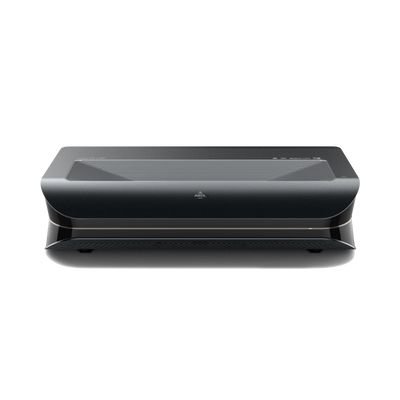
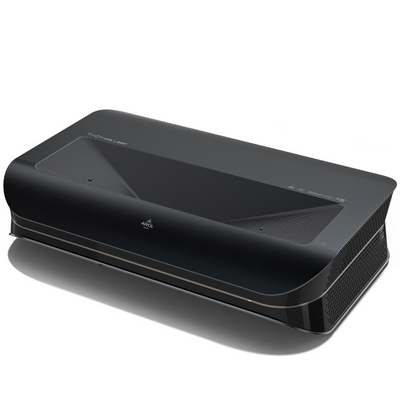
Ultra-short throw/UST (ratio <0.4:1): Sits directly against the wall. A UST projector like the AWOL Vision LTV-3500 Pro embodies this concept: It is simply placed on a sideboard and projects a huge image from just a few centimeters away.
2. The Canvas: An Essential Visual Partner

A white wall is not a substitute for a screen, as its texture and lack of neutrality reduce image quality. For rooms with ambient light are ALR screens (Ambient Light Rejecting) critical, as they absorb ambient light and reflect only the projector's light back to the viewer.
To get the full performance out of a very bright projector like the AWOL Vision LTV-3500 Pro with its 3000 ISO lumens to get the most out of it, a suitable UST-ALR Screen in a living room, not an optional enhancement, but a mandatory requirement`, to achieve a high-contrast, not washed-out image.
Final verdict: Who is upgrading to 4K the right choice for?
YES, the upgrade makes sense for you if...
-
...you are a detail-oriented viewer who values visual quality and authenticity above all else.
-
...exceeds your planned screen diagonal of 100 inches (2.5 meters).
-
...your main sources (streaming, gaming, disc) consistently deliver 4K material.
-
...you want to make a long-term, future-proof investment in your home theater.
No, another solution is probably smarter if...
-
...the budget is the most important limiting factor.
-
...your screen diagonal remains under 100 inches, where the advantages are less pronounced.
-
...you mainly watch regular TV, DVDs, or occasional streaming in lower resolution.
-
...the projector is primarily used in a very bright, non-optimized room.
The decision to choose a 4K projector is less a matter of pure technological necessity and more a personal consideration of viewing habits, room conditions, image size, and budget. The goal is to choose the technology that best serves your personal viewing experience.